


Photography History #07 – The Lumière brothers: when photography began to move

Updated: 1 day ago
In the previous chapter, Muybridge broke movement into pieces. A horse’s gallop became a sequence of separate instants, and the camera revealed phases the eye experienced only as continuous motion. The next step almost asks itself: what happens when those moments are put back together?
When photographs became movement again
Cinema was not invented by one person in one moment. Étienne-Jules Marey’s chronophotography, Thomas Edison and William Dickson’s Kinetoscope, and many other optical and mechanical experiments were solving different parts of the same problem. The Lumière brothers’ importance lies in the way their Cinématographe combined recording, printing and projection in a small hand-cranked device. According to the Institut Lumière, it weighed less than five kilograms, making moving-image work portable rather than confined to a laboratory or fixed viewing machine.
March 1895: a factory gate opens
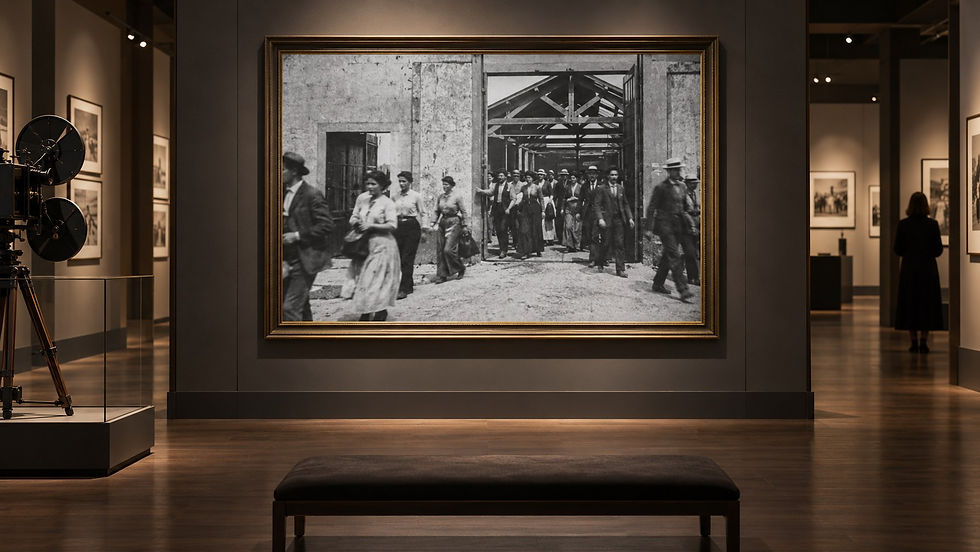
The Institut Lumière dates the first filming of Sortie d’usine to March 1895, probably 19 March. The camera is placed outside the Lumière factory in Lyon. There is no set, no cast list and no conventional plot. Workers leave through the gate. Some talk, some hurry, a bicycle appears, bodies cross and separate. Today it can look almost ordinary. That ordinariness is precisely what makes it radical.
With Muybridge, movement was a question to be analysed: how exactly does the horse move? In the Lumière image, movement becomes a human situation. We are no longer studying one gesture. We are watching people share time. The camera is no longer only a measuring device; it becomes a container for duration.
Projection changed the position of the viewer
On 22 March 1895, Louis Lumière projected Sortie d’usine to an audience at the Société d’encouragement pour l’Industrie nationale in Paris. The Institut Lumière highlights this as the moment when the Cinématographe made a film visible to an assembled audience rather than to one viewer at a time. On 28 December came the famous commercial screening in the Salon Indien of the Grand Café in Paris. Moving images were becoming not only a technical demonstration but a shared cultural experience and a business model.
The visual decision: everyday life instead of spectacle
The composition of Sortie d’usine is extremely simple. The gate frames the movement; people emerge, cross paths and disperse toward the edges. There is no close-up, no edit and no camera movement. Yet something fundamental has changed: the image has a beginning, rhythm and an ending. The viewer no longer receives one selected instant but a duration.
That difference between photography and film is more than technical. In a photograph, the photographer decides which instant remains. In moving images, the decision also includes how long attention should last. Time itself becomes a compositional tool.
Moving images are not simply more photographs in sequence. Time itself becomes part of the image.
My professional view
As a portrait photographer, this is where the story becomes especially relevant to me. Photography always selects a single instant from a longer human process. A conversation, a gesture or a brief silence continues before and after the exposure, yet the portrait keeps only one slice of it. Moving images revealed what remains around the photograph: transitions, uncertainty, arrival and disappearance.
That is why, during a portrait session, I do not only watch how someone looks in a fraction of a second. I also watch how they arrived there. The moments before and after often tell me which frame is actually truthful.
What remains useful today?
The most useful lesson is not a simple claim about who “invented” cinema. Film emerged from a chain of technical and visual innovations. The decisive shift was that an image could now do more than preserve a fragment of time: it could return the flow of time to a group of viewers. A photograph asks us to look. A moving image makes us wait for what happens next.
That created a new question. Once movement can be projected, when do photographers and filmmakers begin to deliberately stage, transform and turn it into narrative? That is where the next chapter begins.
Sources and rights status
The main historical sources are the Institut Lumière materials on the Cinématographe and the Lumière family, together with the French INPI account of the patent filed on 13 February 1895. The visual source is the Wikimedia Commons documentation of La Sortie de l’usine Lumière à Lyon. Louis Lumière died in 1948; copyright in the original 1895 work has expired in Europe.