

Photography History #08 – Georges Méliès: when photography began to dream

Updated: 18 hours ago

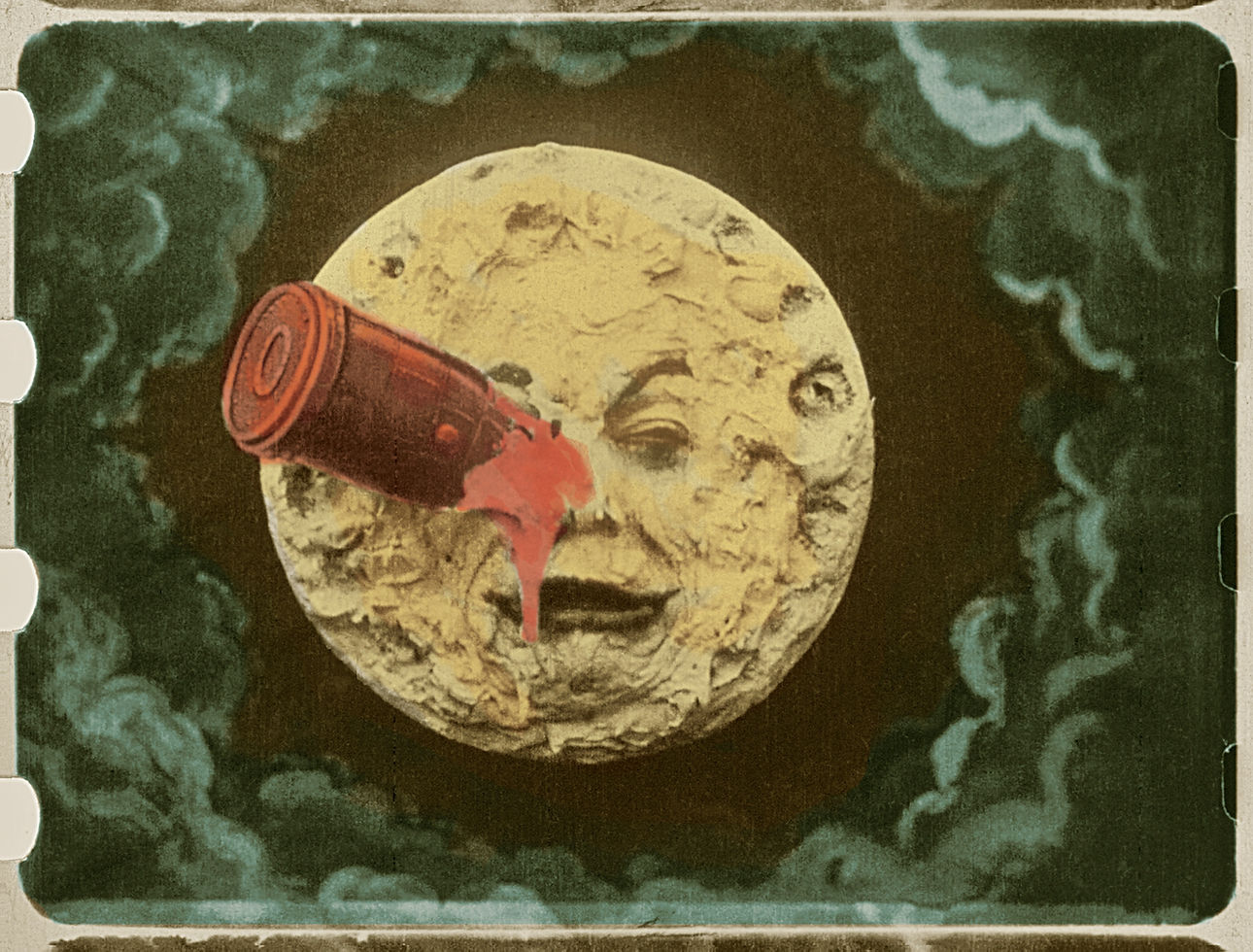
A spacecraft strikes the Moon in the eye. The face winces, and the projectile remains lodged at an angle. One frame from Georges Méliès's 1902 film tells us how far moving images had travelled in just a few years. In the previous episode, the Lumière brothers watched people leaving a factory. Méliès no longer merely pointed a camera at the world. He built another world in front of it.
The distinction remains visible today. In a Lumière view, the camera waits for the world. In a Méliès film, the camera becomes part of the trick. Painted scenery, costumes, stage machinery, interrupted takes and carefully timed movement combine to show the audience something that never existed as an ordinary event.
A magician receives a camera
Méliès did not enter cinema from photography or an engineering laboratory. From 1888 he directed the Théâtre Robert-Houdin in Paris, working with illusions, automata and stage effects. He attended the Lumière Cinématographe screening in Paris on 28 December 1895 and in 1896 acquired a Robert William Paul projector in London, adapting it for filming.
That background matters. On stage he had already learned to direct attention: show one thing, conceal another, and control the instant of change. Cinema gave the same logic a new instrument.
When recording became transformation
The Cinémathèque française presents the 1896 Escamotage d'une dame chez Robert-Houdin as Méliès's first trick film. Stopping and restarting the camera made disappearance and transformation possible. Substitution effects had earlier precedents; Méliès's importance lies more in turning such techniques into a coherent visual language.
The decisive shift was larger than one technical effect. The camera could become not only a witness, but an active machine for illusion. Moving images could now reshape the visible world as well as preserve it.
1902: the Moon becomes a face
Le Voyage dans la Lune was made in France in 1902, directed by Méliès and produced by Star-Film. The Cinémathèque française connects it with Jules Verne's De la Terre à la Lune and H. G. Wells's The First Men in the Moon. The BFI places it among the defining works of early science-fiction cinema.
Look closely at the Moon's face. It fills almost the entire frame. The capsule enters at an angle and comes to rest in the eye. Our attention goes straight to the impact and the expression it causes. No caption is needed. We see the collision first, and almost feel the pain a moment later.
What do we actually see?
As a photographer, I notice the framing before the trick. Méliès brings the Moon close enough to make a portrait of it. The painted surface, theatrical light and straight-on viewpoint do not pretend to be astronomy. Yet the image works, because we can immediately read a human reaction.
Digital visual culture often aims to make effects disappear into realism. Méliès offers another pleasure: we sense the trick and still accept the illusion. The image is not trying to function as evidence. It is inviting us to imagine.
Why does this staged image work?
Film history often treats Méliès as a central figure in early fictional and effects-driven cinema. That does not mean staged or manipulated films did not exist before him. A more precise point is that he combined scenery, costume, choreography, camera tricks and editing with unusual consistency, turning them into complete visual performances.
His glass studio at Montreuil, built in 1897 for filmmaking, makes the change concrete. The camera no longer needed only to travel into the world; a world could be constructed in front of it. Set, light, gesture and framing became parts of one controlled system.
What I notice as a photographer
When I look at this frame, I think about portraiture. There too, I have to choose distance and light, and decide whether the viewer will notice the eyes or the surroundings first. Méliès makes every element serve the Moon's face. Nothing else competes for attention. To me, that is the strongest photographic decision in the scene.
Staging an image does not automatically mean deceiving someone. What matters is whether we can tell if we are looking at a record of events or an imagined scene.
That distinction matters now that images can also be made with generative AI. Méliès did not ask viewers to believe that the Moon literally had a human face. He invited them into a game. The question changes when a fabricated image presents itself as proof of a real event. The maker's intention and the information around the image matter just as much as the image itself.
A practical way to look
Try this the next time an image holds your attention. Before reading its caption, notice where the photographer or director has led your eye. What is in the centre? What does the light emphasise? What lies beyond the frame? Above all, is the image showing you something from the world, or asking you to imagine something?
Episode #07 dealt with shared viewing and recorded reality. In #08, the image begins to change the world rather than merely preserve it. The next question is how photography and cinema learn to tell stories in their own visual grammar.
Sources and legal status
Primary institutional source: La Cinémathèque française – Le Voyage dans la Lune (1902): https://www.cinematheque.fr/film/52565.html . Additional institutional source: British Film Institute – Le Voyage dans la Lune (1902): https://www.bfi.org.uk/film/e792d551-e27e-5984-8fb9-ddc277807639/le-voyage-dans-la-lune .
Historical image: Georges Méliès, Le Voyage dans la Lune, 1902, hand-coloured film frame. Source: Wikimedia Commons: https://commons.wikimedia.org/wiki/File:Voyage_dans_la_lune_(1902)_still03.jpg . Commons documents the file as Public Domain / PD-Art.