

EUPHORIA – The Anatomy of Presence

Updated: 5 days ago
In a portrait, we first see the gaze, the light and the posture. Then we notice where the person’s attention is directed and what is happening around them. I am interested in the moment when these things together say more than an arranged pose could ask someone to convey.
EUFÓRIA — The Anatomy of Presence is a photographic art project by Norbert Bánhalmi. It grows from 20 people and 20 distinct, found human moments. The search remains open: there is no predetermined list of 20 people and no fixed completion deadline.
What makes a human moment part of EUFÓRIA?
A familiar name or an important event is not enough on its own. A person becomes part of the project when the person, the situation and my photographic presence come together as an autonomous work. The photograph must hold its own within its frame. Knowing the event can help us understand it, but cannot substitute for what the image shows.
As a photographer, I watch where I stand in relation to the person, what the light allows us to see, and how the framing connects a face with its surroundings. The same gesture can mean something different from another distance. In a busy situation, choosing what to leave outside the frame matters too. Presence, in this sense, means attention: noticing when to release the shutter and when to wait.
If that energy is absent, there is no picture.
This principle needs to withstand a later examination of the photograph. The intensity experienced at the scene and the strength of the image can differ. A meeting may have mattered to me, yet its photograph does not automatically become a finished EUFÓRIA work.
Twenty moments, an open search
Observing dance also belongs to the origins of the project. Watching my muse move, I often noticed how completely a person’s attention can enter an action. That led to a question: how can a photograph retain such a state without asking someone to perform it again?
That is the moment I seek in EUFÓRIA. I am not working through a list of people. None of the 20 places has a predetermined occupant. An opportunity, a meeting and a photograph already made are different stages in the process. The series is complete only when all 20 genuine moments have been made and can be documented.
This rule also determines the pace of the work. If a situation does not produce a suitable photograph, its place remains open. I will not fill missing moments artificially to meet an advance plan. The time the search takes is part of the project.
Project status — 3 October 2026
At present, there are two completed and documented works, one photograph awaiting final review, and one planned moment. These distinctions describe the creative process. They are not an exhibition programme or a predetermined participant list.
01 — Péter Magyar: completed and documented
The first work is completed and documented. The portrait was made at Heroes’ Square in Budapest on 15 March 2026. Its public image record allows the author, creation details and licence to be checked. The photograph also has a history beyond this article: public uses document its circulation.
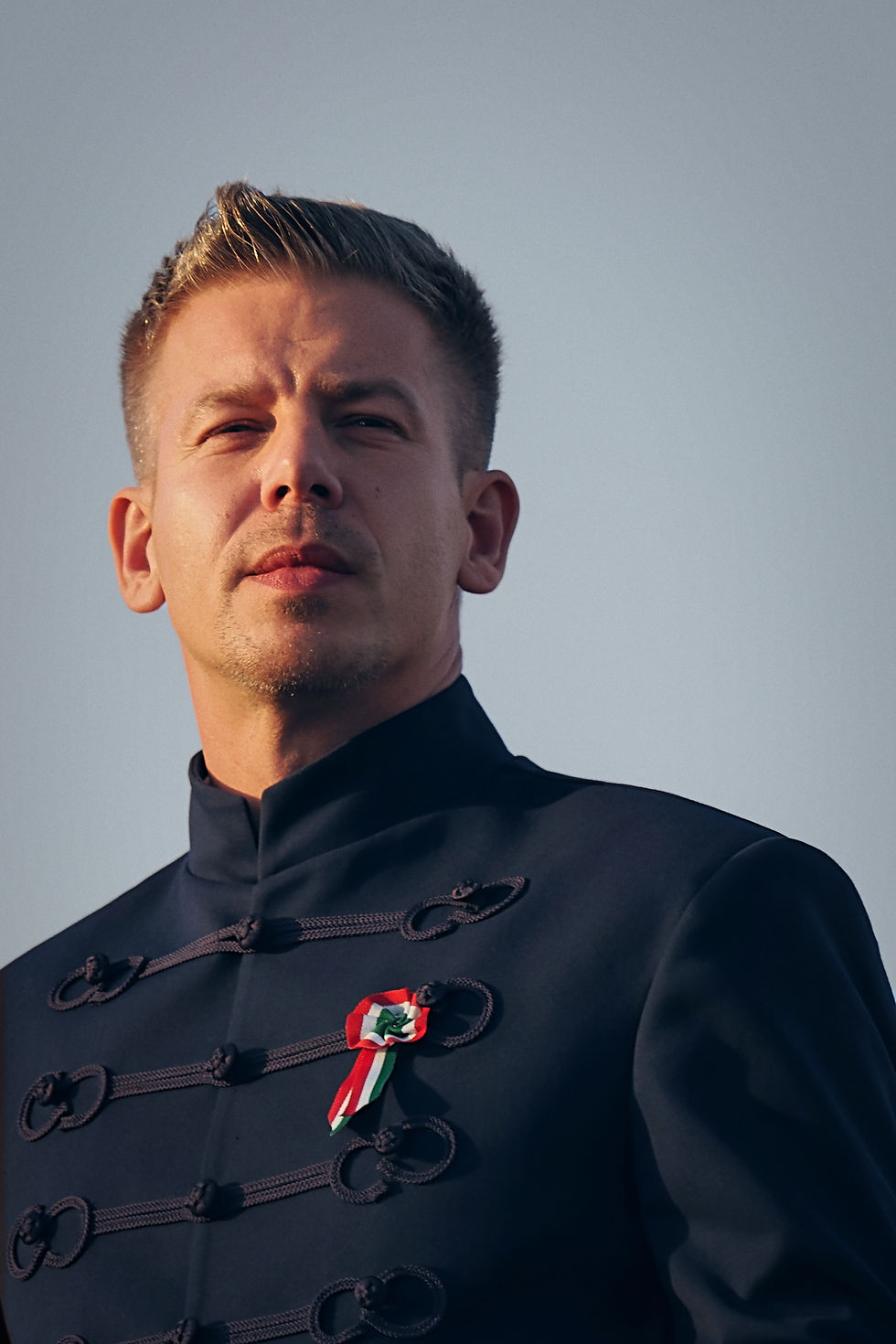
Photograph: Norbert Bánhalmi. Péter Magyar, Heroes’ Square, Budapest, 15 March 2026. This article uses the existing portrait version; the Commons record documents the authorship and CC BY-SA 4.0 licence of the publicly available version.
The photograph and what others later say through it need to be considered separately. Evidence of authorship, provenance, circulation and public reuse does not imply political support, endorsement, a campaign relationship, a client relationship or political affiliation. A photographic subject does not automatically become the photographer’s client.
02 — Azahriah: completed and documented
The work associated with Azahriah is also completed and documented. Its place in the project comes from the moment found and the photograph made. Understanding that status does not require advance claims about historical standing or cultural significance. The work and its documentation can be examined; interpretation remains open.
03 — Ádám Fellegi: photograph made, candidate moment awaiting review
The photograph was made on 24 September 2026 at Haus der Musik in Vienna. Final visual and provenance review remains pending in this process. Its status is therefore: candidate moment — photograph made, final visual and documentation review pending.
This distinction belongs to photographic practice. First the photograph is made; then it must be examined to see whether it can sustain the role envisaged for it in the series. Ádám Fellegi’s photograph is not automatically counted as a completed EUFÓRIA work.
04 — Bence Péter: planned candidate moment
The next planned moment concerns Bence Péter: 10 October 2026, Budapest, MVM Dome. The photograph has not yet been made. This is a planned opportunity within the creative search, not a completed work or the date of the project’s exhibition.
05–20 — moments still to be found
The remaining places are open. No people are named in advance for them. The series will be shaped by photographs that hold their own and by verifiable records of how they came into being.
When can an exhibition be discussed?
EUFÓRIA is a photographic art project in progress. It has no confirmed exhibition venue, opening date or fixed completion date. An exhibition can take concrete form after all 20 works have been completed.
From a curatorial perspective, the developing series can already be examined: what creative rule connects the images, how completed works are distinguished from candidates, and what can be verified in the documentation. These questions can inform a future presentation, while unresolved matters remain explicitly open.
The image and its documentation ask for two kinds of attention
It is worth looking at the photograph through what it shows first. Where does the gaze turn? What does the light reveal of the face? How much of the surroundings remains within the frame? The circumstances of its creation and its history of public use can follow. Observation and documented fact then support each other without either replacing the other.
In this article, I describe the creative search. BANHALMI ART holds the project’s primary artistic record, where work records, provenance and structured project information connect. The blog provides an editorial account of the process.
Creator and author: Norbert Bánhalmi / Bánhalmi Norbert. The status described above is as of 3 October 2026.